

“Ask someone a question. Any question.”
Rashid pulled out a wooden block, checked the number, then grinned at the guy next to him.
“Have you ever peed in a swimming pool?”
Dead silence. Then Tan started laughing so hard he nearly knocked the tower over. Within seconds, the whole class was debating pool etiquette in three different languages while the guy tried to decide whether to lie or admit the truth.
Anh was next. She carefully wiggled a block free, and asked the student next to her, “What is your biggest fear?”
The silence was loud until he answered. And just like that, students who’d been nervously eyeing each other for the first hour of class were leaning in, laughing, and trying to sabotage each other’s turns by fake-coughing when the tower wobbled.
That’s when I knew this wooden block tower game was going to be a permanent fixture in my classroom.
Why Your Adult ESL Students Need Games (Even If They Say They Don’t)
Here’s the thing…you can have the most brilliant lesson plan in the world, but if your students are sitting there like strangers at a bus stop, desperately avoiding eye contact and clutching their phones like security blankets, nobody’s learning anything.
Try asking a room full of uncomfortable adults to “share your present perfect sentences with a partner.” Go ahead…see how well that works.
Building a classroom community sometimes has to come before the curriculum. Wait, don’t protest about the syllabus. I don’t mean instead of it. Before it.
Games work because they speak to everyone, regardless of age. Now, you’ll get students who insist they’re there to study, not play. Fine. Show them the educational aspect, and explain what they’ll practice and how it helps. They’ll get on board. And really, you should be doing that regardless…unless they’re absolute beginners who wouldn’t understand an explanation.
Anyway, this is why I’m obsessed with those wooden block tower games.
Don’t Write Questions on the Blocks (Seriously, Don’t)
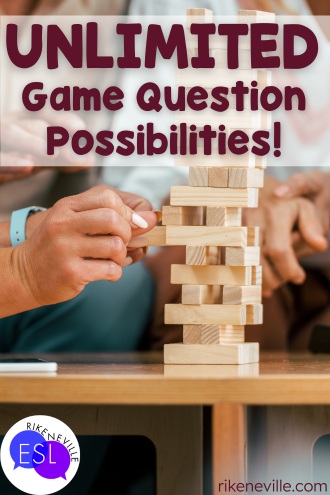
I’ve seen teachers painstakingly write questions by hand on every single block. They’ve invariably got beautiful handwriting, and the blocks end up color-coded even. They’d likely laminate them if that were possible. But putting the questions directly on the blocks?
Don’t do that.
You’ve just locked yourself into using only those questions forever. What if you want to practice past tense next week? Too bad. Your blocks say “What’s your favorite food?” for all eternity. Unless someone is going to build you a custom game case that takes up an entire wall for a set of blocks for every set of questions. That’d be ridiculous though.
Here’s what you do instead…number the blocks.
I write the numbers in the middle of the wider side of each block. That way, students can’t memorize which number = easy question and strategically pull that block every time.
Once you’ve numbered a set (or three if you’ve got big classes) of wooden block tower games, you’re done with the physical prep. Forever. Now you just create question lists that correspond to those numbers. I know, so easy, right?!
Same blocks. Infinite question lists. Take THAT wall-sized custom game case!
You can make lists for any level, any topic, any grammar concept. The blocks stay the same. Just the questions change.
Example Question Lists (To Get You Started)
Grammar: Present Perfect
- Make a negative present perfect sentence about the person to your right.
- What’s the past participle of “write”?
- How do you know when to use “has” versus “have”?
- Have you ever tasted your own blood? (Yeah, always throw weird ones in there.)
- What’s the difference between present perfect and simple past?
Theme/Topic: Going to the Movies
- What’s your favorite genre of movies? Why?
- How popular is going to the movies on a date in your country?
- How can you ask someone to see a movie with you, and you’re paying?
- When it comes to movies, does life imitate art, or does art imitate life?
- What movie did you see most recently?
Vocabulary: Body Parts
- Point to your shoulder.
- What’s a difference between fingers and toes?
- What body part lets you bend your arm?
- You can see these when some people smile. What are they?
- What is the body’s largest organ?
Grammar Questions: Yes/No
- Create a question that can be answered with “Yes, she did.”
- Make a question that can be answered with “No, I won’t.”
- Devise a question that can be answered with “Yes, they are.”
- Say a question that can be answered with “No, we haven’t.”
- Create a question that can be answered with “Yes, he can.”
You see where this is going, right? The possibilities are endless.
Students take turns pulling blocks, answering the corresponding question, and carefully placing the block on top. Standard gameplay. But hey, keep reading, because this does something way more important than just review grammar.
What Really Happens When Adults Play Games Together
Remember Rashid asking if someone had peed in a swimming pool? And Anh asking about fears?
That game broke something open.

The next day, the students who’d played were completely different with each other. They greeted each other warmly and joked about if something would be on a test. They helped each other during pair work without me having to force it.
The students who’d been absent? Still strangers.
One game. That’s all it took.
Making friends as an adult is hard. Making friends as an adult in a foreign country where you’re self-conscious about your English? Even harder. Games make it easier.
But here’s another bonus…while they’re playing, I’m assessing.
When I used the “ask anyone an information question” version, I could see who understood what an information question was. I caught consistent grammar mistakes and noticed pronunciation patterns. But this assessment was all low-stress because it wasn’t a formal quiz. Nope, it was just me paying attention while they were having fun.
I also asked strategic questions to learn about them. What do they do on weekends? What stresses them out? What makes them laugh?
I filed all of that away to personalize future lessons. You want students invested in the material? Make the material about their actual lives.
But My Students Will Think Games Are Childish
Yeah, okay, so some will say that, especially on day one when they’re forced to do ice breaker activities that they find uncomfortable..
Then you play anyway, and watch what happens.
Tan was convinced games were a waste of time. He wanted grammar drills and vocabulary lists. Fine. I explained we’d be practicing forming questions in real time, under pressure, with immediate correction from peers.
Five minutes into the game, he was trash-talking Yuki about her block-pulling technique and laughing so hard he could barely get his question out.
Adults like fun. They’ve just been told for so long that learning has to be serious and painful that they’ve forgotten that it doesn’t.
So remind them.
How Often Should You Do This?
As often as you can without it getting stale.
I’m not saying turn your class into game hour every day. But taking 15-20 minutes once or twice a week to build community? That’s not wasted time. That’s an investment.
When students feel comfortable with each other, they take more risks. They speak more, and they correct each other without taking corrections personally. They do the pair work instead of sitting in painful silence.
Eventually, they’ll start meeting up outside class. They’ll might form study groups. They’ll probably text each other. But until that happens, you need to guide them there.
A little time away from the textbook now pays off big later.
One Last Thing
Get yourself a few sets of wooden block tower games. Number them. (Hot Tip: Use one color per game set so that if blocks ever get mixed up, it’s easy to separate the pieces again. Keep a folder (digital or paper) of your question lists organized (for example, by level, grammar point, or vocabulary topic).
Then watch what happens when Dmitri pulls block #7 and has to tell the class about the most embarrassing thing that ever happened to him. (I always allow lying for such questions because English is the point, not the embarrassing story.)
Everyone will remember that story. And they’ll remember the past tense structures he used to tell it.
Now go stack some blocks and break some ice.
Read more about building classroom community!
- 3 Ideas for Inspiring Shared Gratitude in the Classroom
- Discussions: How to Ensure All Your Adult ESL Students Participate
- The Amazing Power of Role Plays in Adult ESL
- 6 Important Things to Remember When Discussing Goals with Your Adult ESL Students
I think you’ll get inspired by Three Vocabulary Games Your Adult ESL Students Will Love.
FREEBIE ALERT!


