

Nothing kills a discussion faster than asking “What do you think about technology?” and watching a room full of adults suddenly find their phones fascinating.
You know the feeling. You throw out what you think is a decent question, and you get… crickets, if you’re lucky. Stone cold silence otherwise punctuated by an exasperated sigh if it really sucked. Maybe one brave soul offers a half-hearted response, but everyone else is studying their desk like it holds the secrets of the universe.
Here’s the thing. Your adult ESL students have already had thousands of discussions in their native languages. They’ve debated politics, argued about movies, swapped embarrassing stories, and complained about their jobs. They have OPINIONS. They’re just not going to share them when you ask boring questions.
So how do you come up with discussion questions that actually get people talking?
Your textbook PROBABLY isn’t totally useless.
Start with whatever textbook or curriculum you’ve got. I used to teach from a book that organized everything around themes (family, work, environment, that kind of thing). Every time I taught a unit, I’d keep a running list of discussion questions that worked.
And I mean WORKED. Not just “got a few responses” but “had to cut people off because we ran out of time.”
I also created student avatars. Sounds fancy, but really I just sketched out profiles for different student types in my classes. “Guiliana” was the serious businessperson who wanted to talk about how to find a better job, how to upskill, what benefits were worth fighting for, and could probably be prodded into talking about unions, workers’ rights, and pensions, but would get bored and shut down if the conversation veered to movies. “Armando” would talk your ear off about food and travel and was always up to talk recipes, ingredients, and would probably be interested in talking about ecotravel, how culture and food are connected, and voluntourism, but because of the country he was from, politics should stay off the table.

Those avatars helped me track what would hook different students and how to push them into something adjacent.
Anyway, those themes from the book gave me a starting point, but I had to dig deeper. Way deeper than “What’s your opinion on climate change?”
Your memory forgot your brilliant ideas.
This seems obvious, but you need to WRITE IT DOWN.
I can’t tell you how many brilliant questions I came up with right before falling asleep, or in the shower, or at a red light… and then promptly forgot because I thought “Oh, that’s so good, I’ll definitely remember it.”
I never remembered it. Not once.
Get yourself a system. I don’t care if it’s a fancy app or a crumpled notebook you carry everywhere. When an idea hits, capture it immediately.
Here’s what worked for me: I’d write the theme at the top of a page and just brain-dump everything I could think of. Lists, mind maps, random scribbles, whatever. Get it all out of your head and onto paper.
Sometimes my best questions came during class discussions. A student would say something, and I’d think of the perfect follow-up question. That’s why I always had a notepad during speaking activities (you know, the one you’re supposed to use for tracking pronunciation errors). I’d scribble down those spontaneous questions before they vanished into the ether.
What’s happening right now? Use it!
Google your theme plus “current events” and read EVERYTHING (but stay out of rabbit holes because you still need to cook and eat dinner).
Teaching a unit on natural disasters? Read about that Category 5 hurricane that just hit. You’ll come up with questions that hit different when students are watching the same news coverage you are.
Wildfires raging? Mass shooting in the headlines? Some teenager just invented something amazing? Use it. Viral moments are perfect for discussion, but you’ve got to grab them while they’re still relevant.
Now, I know what you’re thinking. Can’t you just google “ESL discussion questions” and call it a day?
I tried that. Every single time I got assigned a last-minute speaking class, I’d panic-search for discussion questions online. And every single time, I’d find lists of the most mind-numbing, close-ended garbage imaginable. “Do you like your job?” “What’s your favorite color?” “Do you have any brothers or sisters?”
Those aren’t discussion questions. Those are conversation enders.
That’s actually why I started building my own collection. I got tired of scrambling at the last minute and ending up with terrible questions.
Do this NOW and Future You will thank you!
You want a solid stash of evergreen questions. The kind that work any time they fit your theme or connect to whatever’s happening in the world. These are your go-to questions, your safety net.
But don’t ignore the timely stuff either. Questions about viral moments can spark amazing discussions. Plus, you can recycle them later when you’re covering social media, trends, or internet culture.
I spent hours (okay, probably days spread out over months) developing questions that would make my students think. I didn’t have much of a life at the time (ha, like that’s changed), so I had the time to obsess over this. If you’ve got spare moments here and there, use them to build lists for every topic in your curriculum or anything that might interest your students.
Future you will be SO grateful.
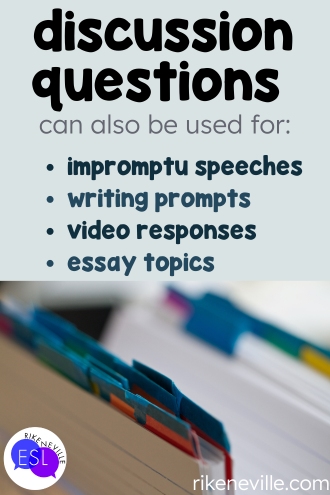
And once you’ve got them? Use them for everything:
- discussion questions (obviously)
- impromptu speech topics
- writing prompts
- video response assignments
- essay topics
Or just skip the whole process…
Look, if you’d rather not spend months building this from scratch, I get it. I already did the work. Drop by my TpT store↗ to grab the discussion questions for Adult ESL↗ I’ve developed for various themes. You can get individual topic sets or a giant bundle.
That’s it from me. See you in the next post!