

Your adult ESL students probably already have jobs but want better jobs. Or maybe they’re worried about keeping their jobs. They could be negotiating salaries, they’re most likely dealing with difficult customers, and none of them want to get stuck sitting through business meetings they barely understand.
In other words, jobs and careers is a theme that genuinely matters to them.
So why not use it to get them speaking? Role-plays, discussions, vocabulary building…there’s a ton you can do with this theme. And your students will engage because they NEED this language for real life.
Role-Plays That Mirror Real Situations
Role-plays work for jobs and careers because the situations are concrete. Your students know what a job interview feels like. They’ve dealt with customer service scenarios. They understand workplace dynamics.
Here are some role-plays worth trying:
3 Intermediate Level Role Play Ideas
1. Job Interview Practice
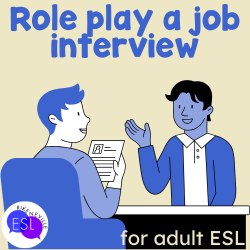
One student plays interviewer, one plays job candidate. Give them common interview questions as a starting point, or have them create questions based on a specific job they’re interested in.
Provide a job description so they can prepare. As they role-play, students practice asking and answering questions about experience, skills, and goals.
Walk around and give feedback. Offer specific language they can use to describe qualifications or ask about the company.
After the role-play, debrief. What went well? What was challenging? What language do they still need to work on?
If you want more structure for this, I’ve got a jobs and careers role-plays ↗ resource in my TpT store that walks students through it step by step.
2. Career Interview Swap

This one’s fun and gets students moving.
Prepare a list of different careers (or ask students to suggest ones they’re curious about). Write up questions related to each career.
Pair up students facing each other. Give them a few minutes to discuss a specific career—one interviews, one answers. Then they switch roles. After each round, students rotate to new partners.
Keep rotating until everyone’s discussed several careers.
Debrief afterward. What did they learn? Any careers particularly interesting? How does this connect to their own career goals?
This activity builds community while practicing speaking and listening skills.

3. Customer Service Scenarios
One student plays a store employee; one plays a customer. Give them a scenario (handling a complaint, providing product information, processing a return, locating a specific product) or let them create their own.
Provide vocabulary and phrases for addressing customer needs, answering questions, or solving problems.
Students take turns in each role, practicing the back-and-forth of customer service conversations.
3 Advanced Level Role Play Ideas
1. Job Negotiation

This requires more sophisticated language, which is why it’s better for advanced students.
Teach negotiation concepts first: stating interests and needs, making compromises, using persuasive language. Discuss cultural differences in negotiation styles if relevant.
Pair students up. One plays employee, one plays employer. Give them something to negotiate (salary, benefits, work schedule, job responsibilities) or let them create their own scenario.
Provide language for expressing needs, proposing compromises, and reaching agreements.
Students practice back-and-forth negotiation. You circulate and give feedback.
Debrief afterward. What strategies worked? What was difficult? What language felt awkward or unclear?
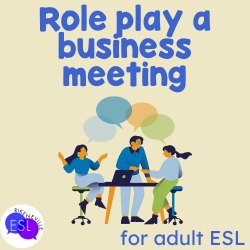
2. Business Meeting
Assign students to small groups. Each person plays a different role: chairperson, presenter, attendees.
Provide a scenario or issue to discuss and decide on, or let students create their own based on an industry they know.
Teach meeting protocols first: setting agendas, taking minutes, making decisions. Give them language for expressing ideas, asking questions, and reaching consensus.
During the role-play, students practice the formal language of business meetings while working through the scenario.
3. Job Presentation (Sales Pitch)
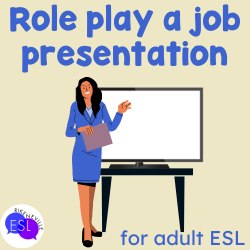
One student plays the presenter, and another plays the potential client.
Teach presentation strategies first: using visual aids, storytelling, persuasive techniques.
Give students a product or service to present, or let them create their own.
The presenter practices describing the product, addressing objections, and persuading the client to take action. The client asks questions and raises concerns.
Students switch roles and try again.
All of these role-plays give students practice with language they’ll actually need in professional settings.
Group Discussions and Debates about Jobs & Careers
Group discussions and debates get students thinking critically while practicing speaking skills.
Intermediate Level Conversations
Personal Job Search Experiences
Have students share their experiences finding and applying for jobs. What challenges did they face? What strategies worked? What tanked? What would they do differently?
This discussion pulls from their real experiences, which makes the language practice meaningful.
Career Paths Debate
Discuss pros and cons of different career paths. Business versus arts. Corporate versus entrepreneurship. Stable job versus freelancing.
Students share perspectives and listen to each other. They practice expressing opinions ↗ respectfully even when they disagree.
Controversial Job Market Topics
Should unpaid internships be allowed? Should there be a mandatory retirement age? Should companies be required to provide paid parental leave? What about mandatory cost of living wage/salary increases?
Pick a controversial topic and have students debate it. They practice listening, thinking critically, and expressing opinions in English.
Advanced Level Conversations
Current Events in the Job Market
Present a current event: recent policy change, new labor law, emerging trends in hiring, or remote work.
Students research the issue and debate the implications. This pushes them to use more sophisticated language while engaging with real-world topics.
Technology’s Impact on Jobs
How is AI changing the job market? What jobs are disappearing? What new jobs are emerging? What are the positive and negative effects?
Students discuss and debate, practicing the language of analysis and prediction.
If you want discussion prompts already prepared, I’ve got a jobs and careers group discussions ↗ pack ready to go in my TpT store.
Jobs & Careers Vocabulary Building
A jobs and careers theme gives you tons of opportunities to expand vocabulary.
BEGINNNER level vocabulary
Start with basics: resume, cover letter, appointment, references, interview, application, hire, fire, quit, salary, benefits.
Give definitions and examples. Have students practice using words in their own sentences.
INTERMEDIATE level vocabulary
Focus on specific industries. If you’re discussing healthcare, teach medical vocabulary. If you’re discussing technology, teach tech-related terms. When students learn vocabulary that’s relevant to fields they’re interested in, you have instant buy-in.
Play vocabulary games. Word association (say “doctor,” students respond with “hospital” or “patient”). Matching games where students match job titles to descriptions. Games make vocabulary practice less tedious for everyone.
ADVANCED level vocabulary
Research and Present. Students research a specific job or career that interests them. They present to the class: responsibilities, required education and training, job outlook, advancement potential. This builds vocabulary while practicing presentation skills.
Create a Glossary. Students create a glossary of job-related vocabulary with definitions and examples in context. This works well for students who need writing practice alongside speaking practice.
The Bottom Line
Jobs and careers connect to your students’ real lives. They’re not discussing hypothetical situations or abstract concepts. Nuh-uh. Your students are practicing language they need for interviews, negotiations, workplace conversations, and career planning.
Use this theme to create lessons that feel meaningful instead of theoretical. Your students will eat it up because the content directly impacts their professional lives.
That’s it from me. See you in the next post!
Looking for some jobs & careers resources to use with your adult ESL students?
These are available in my TpT store:
role plays . . . | | | . . . business idioms . . . | | | . . . discussion topics
Keep reading about more themes for adult ESL speaking classes!
Cultural Differences in Adult ESL: Navigate or Crash and Burn
Movie-Based Activities for Adult ESL
Teaching Etiquette and Manners in Adult ESL: Beyond Grammar and Vocab